
.png)
Tracing AI's Path Into UK Culture
An unlikely pairing
In summer 2025, a group of 40 Goldsmiths and University of the Arts London students participated in an intensive program of workshops at Tate Modern, building AI-generated artworks and immersive responses to the collection. This residency was developed in collaboration with Anthropic, one of the world's foremost AI labs. It's an unlikely pairing on paper: a 120-year-old public institution and a frontier AI company, working out loud about authorship, ethics and machine creativity. But it's also a useful snapshot of where Britain's art and tech scenes have landed after a few years of rapid convergence: technology is no longer just the subject matter, but is being absorbed as method, infrastructure and collaborator.
Similar signals are coming from Arts Council England, who in January 2026, announced the inclusion of Digital Arts as a recognized artform, the first public arts funder to take this step. More recently, they published a report stating that between 2019-2025, nearly £4 million of Arts Council investment went into projects that supported artists to experiment with AI, develop new skills, and explore its wider implications for society. The report underlines that creative practitioners are not simply adopting technology but shaping its direction and meaning within their communities.

This piece traces how that shift has taken shape, through corporate sponsorship, new research infrastructure, the practitioners, and the frictions nobody's fully resolved, and asks how much of it is built to last.
"AI" here spans a wide range: from the generative chatbots and image tools reshaping individual practice, to the digital and interactive works institutions and brands are commissioning and displaying, to the machine-learning classifiers and infrastructure being built into institutional and industry workflows. The focus is on what institutions, companies, and practitioners are doing with it.
The corporate-cultural alliance wave
Sponsorship of AI in UK culture has moved through several stages in as many years: fund a show, fund a programme, put your own people in the building. Aside from digitizing collections among UK institutions like the Tate and British Museum, in 2019, Google Arts & Culture supported Barbican’s AI: More than Human exhibition and in 2024 Deepmind launched “Visualising AI” inviting artists to depict key themes of artificial intelligence, demonstrating a deeper involvement in the programming. Microsoft extended its involvement into ongoing education through a multi-year commitment via a digital accelerator program with the National Youth Theatre with the goal of teaching the next generation how to use AI in an informed and responsible way to make innovative creative content.
Anthropic's backing of Tate Modern's Electric Dreams: Art and Technology Before the Internet put it alongside Gucci and the Hyundai Tate Research Centre in legacy-sponsor territory, usually preserved for luxury and automotive brands. But its parallel residency with Goldsmiths and UAL did something the exhibition sponsorship didn't: it put Anthropic's own staff in the room with students and curators for weeks, to work on questions of authorship and machine creativity. That's the difference between renting a wall and joining a seminar; it's the same shift, at greater depth, that shows up in the R&D hubs discussed next.
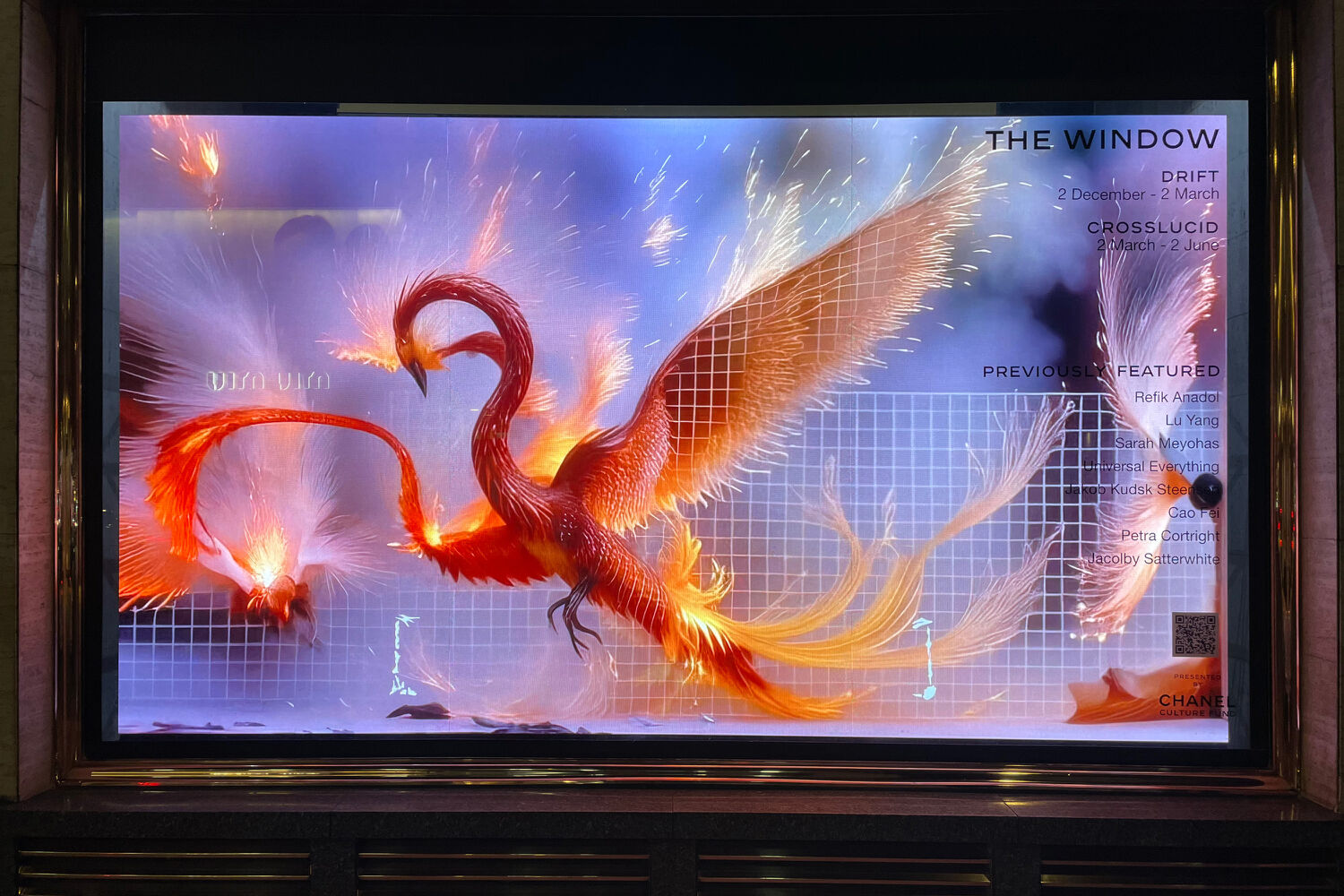
We’re also seeing brands beyond the technology space embrace digital art as a way of showcasing innovation and forward thinking. UBS, a financial services provider long known for backing art fairs like Art Basel, is opening a digital art museum in Hamburg later this year. The CHANEL Culture Fund has been frequently featuring artists experimenting with new media in The Window, a free digital public art installation at one of its London stores. Where AI labs use cultural patronage to buy critical framing for their technology, these brands are buying the same association in reverse: proximity to digital art as evidence of forward motion, independent of what the technology itself does.
That distinction matters because it sharpens the question underneath both patterns: are institutions gaining genuine R&D capacity and critical distance, or lending legitimacy to sponsors who want to be seen shaping culture rather than disrupting it? The evidence points both ways rather than to a clean answer. Anthropic's residency gave Goldsmiths and UAL students hands-on access to a frontier lab's staff and thinking, which is something no exhibition sponsorship provides.
The R&D hub boom
Beneath the headline sponsorships, quieter networks are also being built. Serpentine's Arts Technologies department has spent five years formalizing "creative R&D" as a category in its own right, publishing yearly Future Art Ecosystems (FAE) reports. FAE is described as an annual strategic briefing that provides analytical and conceptual tools for the construction of 21st-century cultural infrastructure: the systems that support art and advanced technologies as a whole, and respond to a broader societal agenda. Its latest publication, FAE 5 on Art x Creative R&D, aims to educate and influence policymakers to recognize artistic experimentation with advanced technology as a legitimate innovation pipeline, not a side activity. In parallel, Serpentine also runs a Creative AI Lab in partnership with King’s College which critically engages with AI/ML technologies.
Somerset House Studios has gone further institutionally and, with support of the Rothschild Foundation, launched n-Space in October 2025 - a dedicated interdisciplinary hub with Goldsmiths and UAL, building on earlier programmes like PATH-AI with the Alan Turing Institute. These examples, as well as Watershed's long-running Pervasive Media Studio in Bristol, and the Royal College of Art's first AI Festival, a week-long programme of talks, workshops and exhibitions run by RCA's own research community in February 2026, show a pattern:
The UK is quietly building an infrastructure of ongoing art-tech experimentation, rather than treating it as a one-off exhibition trend.
These examples are illustrative, not exhaustive. None of these necessarily presents the best path forward, but rather approaches to answering different questions: how to influence national policy framing, co-deliver institutional capacity, or provide a long-running practitioner infrastructure. Between them sits a much wider range of possible shapes, hybrid models blending policy influence with practitioner output, multi-partner alliances spanning more than one institution, or self-produced programmes running without a hosting museum or gallery at all, each with a different mix of legitimacy, control, and cost. Choosing the right shape isn't a matter of picking from a known list; it's a matter of matching structure to what an organisation is actually trying to achieve, a judgement call most funders and institutions are better served making with specialist input than by default.
Behind the scenes
On the Anthropic-Tate residency, Chris Follows, UAL's Emerging Technologies lead, says most students had never used Claude before staff introduced both the chatbot and developer platform directly and it opened many new ways of working for them:
Treating the tool itself as material to be interrogated, not just used.
The residency opened with an AI ethics panel on day one. Follows says that framing shaped how the rest of the month was delivered, with staff and academics scrutinising the same questions throughout. Follows adds a sharper data point: over ten years running UAL collaborations, Anthropic and Synthesia are the only two AI companies to engage openly with student education there, a small sample, but a real measure of how rare this still is.
Joe Duggan, Head of Communications & Digital at the National Youth Theatre, shared similar thoughts about the importance of framing new tools responsible: “We want to equip the next generation of creatives with the tools and knowledge to navigate the challenges and opportunities new technologies, including AI, present responsibly and creatively. From how to own your likeness and voice, to how to use motion capture to tell stories in new virtual worlds, our free Digital Accelerators with Microsoft around the country democratised access to new tech, experts and critical conversations about the future of storytelling.”
When asked what companies might expect to gain from partnership with institutions, Follows stated, "I'm not sure most companies really know what they will get from a collaboration with art students, other than a positive story for their outreach." But he also added that every partner has been surprised by the calibre of student work, suggesting the value, even if unplanned, turns out to be real. For anyone weighing whether to fund a hub or residency, that's the takeaway: expect the gap between stated rationale and actual return, rather than being surprised by it.
Friction points
Not everyone in the sector is celebrating. Anthropic's own research into how creatives are using AI found real anxiety beneath the productivity gains: peer judgement, fear of being sidelined, and a threat to a professional identity built on craft. The hard data tells a mixed story. Creative businesses cite distrust of AI's safety and transparency as their top barrier to adoption, well above the economy-wide average (10.1% vs. 5.7%), and unequal access to finance risks widening that gap for underrepresented founders, both signs the anxiety is grounded in something real.
But within visual and performing arts specifically, the subsector adopting AI slowest, most non-adopters say no barrier has held them back, suggesting disengagement rather than fear. And a February 2026 study in the Journal of Cultural Economics found little evidence of short-run earnings decline among AI-exposed artistic occupations through 2023, though it stopped short of ruling out harm as adoption deepens. The data, in other words, hasn't caught up with the anxiety yet.

Beyond the labour-market data, reports by UNESCO and the British Academy highlight further challenges alongside the opportunities. These include non-consensual data extraction, biases, homogenisation of culture, and job displacement among others.
Swaneet Singh, Co-President of Eros Innovation, a media and entertainment company now building AI-driven production and cultural-data infrastructure, raises the concern a level higher, arguing that sovereign data protection should be treated as a cultural priority as much as a technological one:
I think sovereign data needs to be protected at any cost. What I'd like to see is the UK taking steps to protect its sovereign data, because the UK is very different from other Western countries, it has so much culture.
Singh argues that sovereign data needs to be protected at any cost, and that the UK has yet to take real steps to protect its datasets from moving offshore. He frames this as more than economic self-interest: "the UK is very different from other Western countries, it has so much culture," he says, and adds simply, "We're British." For Singh, the case for protecting UK datasets isn't separate from protecting a distinct cultural inheritance, it is that case.
Individual institutions are starting to formalize responses to a version of this same concern: Art UK's AI policy commits to protecting artists' copyright and keeping "the creative integrity of the artwork intact" when AI touches image processing, and to preferring providers with strong environmental credentials, bringing evidence that some of this is moving from open question to institutional practice. A March 2026 House of Lords report went further still, warning that UK creators risk being sidelined by unlicensed, overseas-trained AI models, and calling for the development of sovereign AI models as part of a "licensing-first" regime, a recommendation that echoes Singh's argument almost word for word.
.jpg)
That tension runs underneath nearly every partnership in this piece: institutions are eager to be seen as forward-looking, funders want measurable innovation, and artists are caught navigating stigma, ethics, and the genuine risk of being deskilled or replaced by the very tools they're being funded to explore.
Getting that balance right will take more than good intentions. It's a question of judgement, and not every institution or sponsor is equally equipped to make that call.
Where it's heading
If the last years were about establishing AI's presence in UK cultural institutions, through sponsorship, research labs, residencies and pilot programmes, the next phase will be about consolidation, especially as AI becomes more rooted in all our daily lives. Somerset House's n-Space is a three-year commitment rather than a one-off; Serpentine is treating Future Art Ecosystems as an annual strategic briefing rather than a single report; and academic bodies are now building PhD studentships specifically to study how value and labour move through art-technology networks.
That consolidation isn't confined to museums and studios. Singh notes that Eros Innovation began in film, and argues the disruption is heading straight into the content industry itself: "If there's anything in this world that's going to be disrupted by video language models, it's going to be content." Eros isn't waiting to find out. "We've already started two films," he said, and by the time he spoke with Artamonovskaja in July, the company had already committed £265 million to a UK production slate at London Tech Week the previous month, alongside licensing its cultural dataset to a newly established British operation. It's a concrete instance of the shift from pilot to production that the sector-wide data in this piece shows most Creative Industries firms are still yet to make.
The open question for 2026 and beyond is what kind of shape this settles into: durable infrastructure for UK creative R&D that holds steady regardless of who's funding it, or a landscape still tied to the priorities of whichever sponsors and companies happen to be active. Either way, the partnerships taking form now are the ones that will answer it.
__________________
Over the past decade we worked the commercial side of emerging technology directly, guiding early-stage art-tech ventures and platforms, including .ART and Artsper, through launch, go-to-market strategy, and partnership structuring. Separately, we've also sat inside the institutions this piece is about: our team has taught and presented at Serpentine, Tate, Sotheby's Institute of Art, and Christie's Education, and worked on comparable art-technology collaborations, including Musée d'Orsay's Le Code d'Orsay, Ars Electronica, and Museum of Moving Image's Museum Without Walls. That combination, commercial experience building these ventures, and direct exposure to the institutions that host them, is the lens this piece is written from.


.png)
